

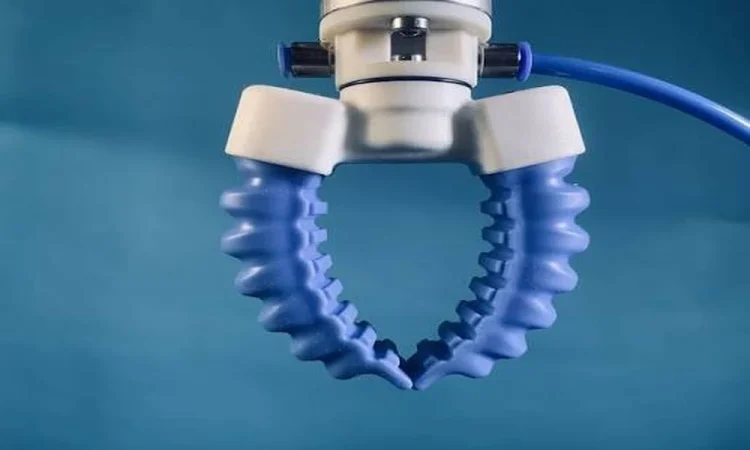

The parallel two-finger gripper is one of the most familiar tools in industrial robotics. Its basic principle is uncomplicated: two opposing fingers move toward or away from each other to hold a workpiece. Despite that simplicity, the design can be used in a surprisingly wide range of applications.
Machine tending, pick-and-place and assembly all make use of two-finger gripping because many manufactured components provide predictable surfaces that can be held from opposite sides.
Simple mechanics can still provide flexibility
A modern 2 finger gripper does not necessarily operate like a fixed pneumatic clamp. Electric models can provide adjustable stroke and gripping force, allowing the same tool to handle multiple part sizes.
OnRobot’s current RG2, for example, is an electric two-finger gripper with adjustable stroke and force, customisable fingertips and integrated software intended for applications such as material handling, machine tending and assembly. These features illustrate why programmable gripping can be useful in high-mix production.
The important advantage is not simply that the fingers move electrically. It is that the gripping parameters can be changed when the product changes.
Finger design determines the real contact
The gripper body provides motion, but the fingertips are what actually touch the part. Their design can therefore make the difference between a stable grip and an unreliable one.
Flat pads may be appropriate for rectangular products, while cylindrical parts can benefit from shaped or V-profile fingers. Softer contact materials may protect sensitive surfaces, and custom profiles can locate dedicated parts more accurately.
There is a trade-off. Highly customised fingers can improve performance for one component but reduce the ability to handle another. Manufacturers producing several product variants should decide whether interchangeable fingers or a more general geometry provides the better balance.
Internal gripping can be useful too
Two-finger systems do not always have to clamp the outside of a component. Some parts can be gripped from an internal feature, depending on the gripper and finger design.
This can leave external surfaces accessible for machining or inspection and may provide better location on particular components. It also demonstrates why robotic handling does not have to copy the way a person currently picks up the part.
A human hand may use the most convenient contact points, while a robot benefits from whatever grip is most repeatable.
Machine tending shows the strengths of the design
CNC machine tending is a natural application for parallel gripping because blanks and finished parts generally have controlled geometry. The robot can remove the completed component, load a new workpiece and repeat the sequence while the machine performs the machining cycle.
Real production conditions still need to be considered. Coolant, chips and restricted access can affect grip reliability, and the fingertips must provide adequate holding force even when surfaces are not perfectly clean.
Cycle time can also influence the layout. Some systems use more than one gripping element so that raw and finished parts can be handled efficiently, although this adds weight and complexity at the robot wrist.
Feedback improves unattended operation
A robotic cell should ideally know whether the expected pickup actually occurred. If the fingers close without a part between them, continuing the program may create problems at the next station.
Position or grip feedback can help identify these situations and allow the system to stop or respond appropriately. This becomes particularly important when machines operate for periods with limited human supervision.
Two-finger grippers remain popular because they solve a common industrial problem without unnecessary complexity. When part geometry, finger design, gripping force and robot capacity are considered together, a relatively simple mechanism can provide reliable handling across a broad range of manufacturing tasks.