

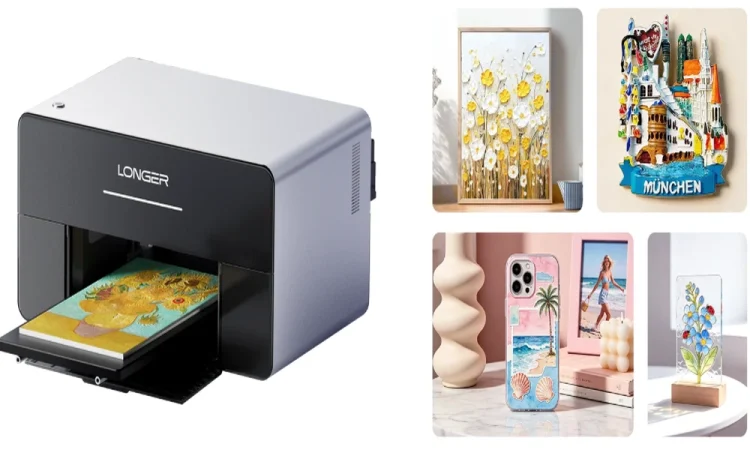

A decade ago, small-batch custom manufacturing faced a persistent bottleneck. If a studio needed to print high-definition, multi-color designs directly onto metal, wood, acrylic, or glass, the options were stark: invest hundreds of thousands of dollars in industrial flatbed machinery or outsource to large-scale print factories with high Minimum Order Quantities (MOQs). For agile creators, hardware startups, and boutique brands, this structural dynamic meant long turnaround times, high upfront costs, and zero room for rapid prototyping.
Over the past ten years, I’ve watched this barrier dissolve. The single catalyst behind this transformation is the evolution of the Desktop UV Printer. Compact, highly precise, and versatile, these compact flatbeds have brought industrial-grade capability directly onto the workbench. By eliminating setup friction and opening access to almost any rigid or semi-flexible substrate, modern UV printing technology is redefining what it means to manufacture at a small scale.
The Evolution: From Industrial Giants to Desktop Precision
When I first entered the printing and hardware industry, a standard UV Printing Machine required dedicated floor space, heavy three-phase power, and a team of specialized technicians to calibrate the print heads and UV curing lamps. Industrial printers remains essential for high-volume production, but their unit economics fail completely when applied to small, customized batches.
The shift toward desktop platforms changed everything. Engineers successfully miniaturized key components-high-density piezo printheads, UV-LED curing arrays, and micro-stepper motors-without sacrificing print fidelity. Today’s desktop units offer micro-droplet accuracy, capable of rendering 1440+ DPI resolution, complex gradient fills, and tactile 3D textures on items as small as a flash drive or as large as a specialized enclosure.
Why the Desktop UV Printer Fits Small-Batch Production
Small-batch manufacturing thrives on agility, customization, and speed-to-market. Here is why the modern desktop format excels across all three:
1. Unmatched Substrate Versatility
Unlike traditional inkjet platforms that rely on porous media like paper or textiles, a UV platform utilizes ultraviolet light to instantly cure specially formulated inks. The moment ink hits the surface, UV-LED light polymerizes it, bonding the print instantly. Whether you are printing on brushed aluminum, cast acrylic, phone cases, leather goods, or coated wood, the material surface requires minimal pre-treatment.
2. Instant Curing and Zero Lead Time
In traditional screen printing or pad printing, preparing screens, mixing inks, and waiting for thermal drying cycles consume hours. A Desktop UV Printer eliminates prepress friction entirely. You send a digital file directly to the RIP software, hit print, and receive a fully cured, scratch-resistant product within minutes. There is no dry time, no risk of ink smudging, and no need to store chemical solvents on site.
3. Direct-to-Object Tactile Effects
Beyond standard CMYK and white inks, high-spec UV systems utilize clear gloss (varnish). By laying down multiple passes of clear ink, manufacturers can create raised textures, braille text, simulated leather grain, or spot-gloss highlights. This adds a physical dimension to products that was previously impossible to achieve without expensive tooling or molding.
4. Frictionless On-Demand Customization
Because digital printing requires no physical plates or dies, printing 50 identical items costs the exact same per unit as printing 50 completely unique items. Small-batch manufacturers can run personalized serial numbers, localized branding, or limited-edition artist designs without incurring extra operational overhead.
Key Operational Considerations
While the technology offers clear advantages, implementing a desktop flatbed into a production workflow requires attention to operational details:
Surface Pre-treatment & Primers: Materials like stainless steel, glass, or un-coated ceramics have low surface energy. Applying a chemical wipe-on primer before printing ensures proper ink adhesion and long-term durability.
White Ink Maintenance: Because white UV ink contains heavy titanium dioxide particles to achieve opacity, it requires automatic circulation systems or manual agitation to prevent pigment settling and nozzle clogging.
Curing & Ventilation: UV curing emits faint ozone and chemical odors during polymerization. Operating the machine in a space with active carbon filtration or dedicated ventilation keeps the workspace safe and comfortable.
The Future of Localized Manufacturing
Having guided numerous workshops and product teams through hardware upgrades, I view the desktop format not as a stripped-down version of industrial machinery, but as a distinct manufacturing tool in its own right. It bridges the gap between digital prototyping and full-scale commercial manufacturing.
As small-batch brands prioritize regional production, reduced inventory waste, and hyper-customization, direct-to-substrate printing will remain central to hardware innovation. Investing in a reliable UV Printing Machine gives small teams complete control over their production cycle, turning digital concepts into finished, market-ready goods within a single afternoon.